
Honest good working local company. The amount they quoted me on the phone was the price I paid after the service was completed.
Dryer vent cleaning in Bloomfield, NJ
If a load takes two cycles where it used to take one, the machine is not failing. The duct behind it has narrowed, and the dryer is working against it.
5.0from 38 Google reviews20 towns · open 7:00 AM–9:00 PM
The short answer
Dryer vent cleaning means clearing the entire duct that carries hot wet air from the back of the machine to the hood on the outside wall — not the lint screen, which you already empty, and not the first arm's length behind the dryer, which is all a vacuum nozzle reaches. Lint gets past the screen on every cycle, settles wherever the duct bends or runs uphill, and gradually narrows it. The machine responds by running longer, which is the first sign most households notice: a load that used to dry in one cycle now takes two or three. It is also a fire risk that the trade takes seriously, because lint is dry fibre packed into a hot pipe. In a Bloomfield two-family or an older single-family with the laundry in the basement, that run is often long, has several bends, and has never been opened.
The trap catches some of it. The duct catches the rest
Every cycle sends lint past the screen — that is normal and no screen prevents it. Where it ends up is decided by the shape of the run. Lint settles at elbows, on any section that rises, and anywhere the duct sags between supports, and it builds from the wall of the pipe inwards until the opening is a fraction of what it was. The machine cannot tell you this directly, so it tells you sideways: cycles get longer, the top of the dryer runs hotter than it used to, the laundry room feels humid, and clothes come out warm rather than dry. By the time there is a burning smell the run is badly restricted, and that is not a stage to wait through.
- Longer cycles are the first sign, and usually the only early one
- A hot dryer top and a humid laundry room follow
- A burning smell means the run is badly restricted already
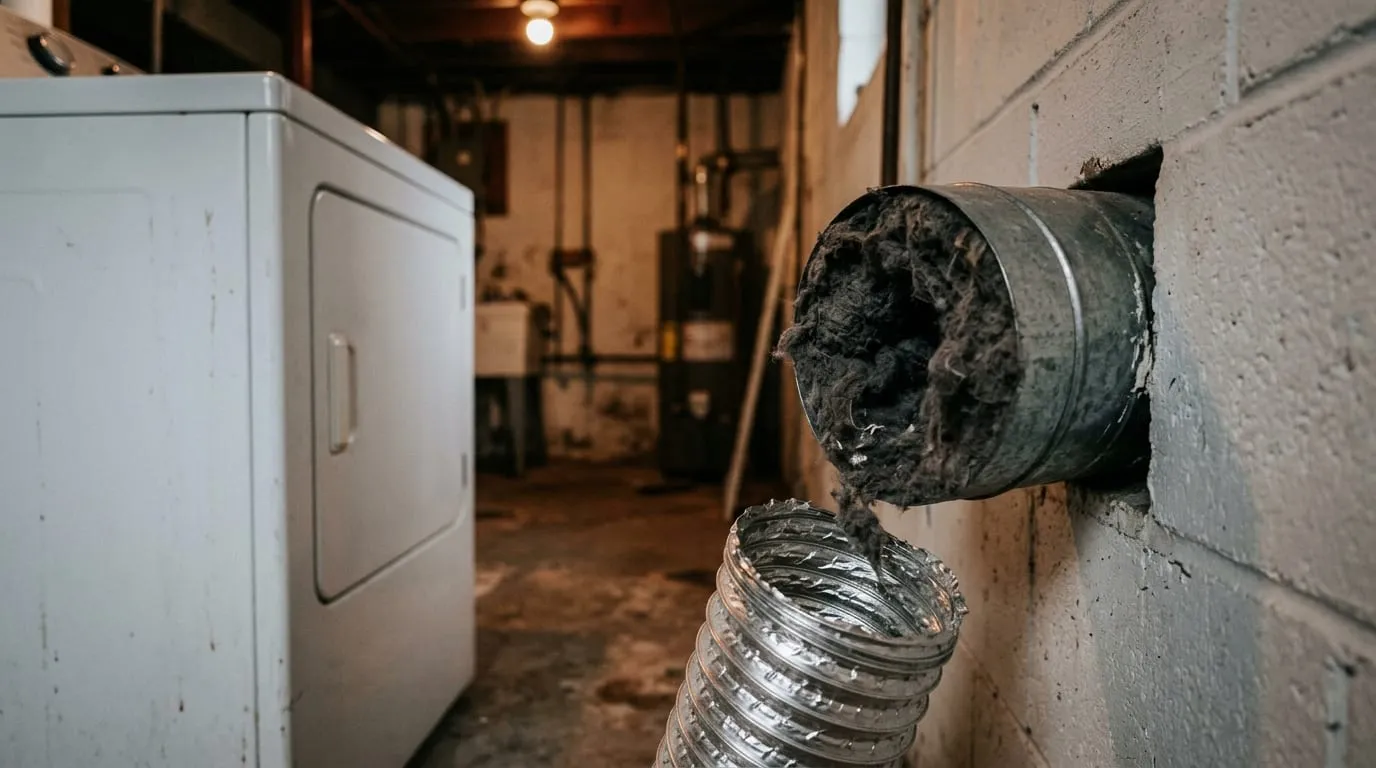
A brush without suction does not remove lint. It moves it to the next bend and leaves you paying for the same job twice.
Cleared from both ends, with suction on it
A rotary brush pushed down a duct without suction relocates lint rather than removing it, and the place it ends up is usually the bend just past where the brush stopped. So the run is opened at the machine end and at the hood, brushed through with a vacuum drawing at the same time, and then checked from the outside while the dryer runs. That last part matters more than it sounds: airflow at the hood is the only honest measure of whether the work achieved anything, and it is something you can stand outside and feel for yourself. Where the duct behind the machine turns out to be the flexible foil kind crushed into the gap behind the dryer, we say so — no amount of brushing fixes a duct that is folded shut.
What makes a Bloomfield run harder than most
Two things, and both come from the age of the housing. First, the laundry is very often in the basement, which means the duct has to travel up and then out, and lint settles on every rising section by definition. Second, in the two- and three-family stock along the avenue the duct frequently runs a long way inside the structure before it reaches an outside wall, sometimes through a joist bay nobody has opened since the house was built. Long runs with several bends need clearing more often than a short straight run to a side wall, not less, and they are also the ones where the exterior hood is somewhere awkward and has been quietly blocked for years. Where the run is genuinely too long or too convoluted for the machine, we will tell you that too.
- Basement laundry means a rising run, and lint settles on every rise
- Long internal runs in divided houses need clearing more often, not less
- A hood on an awkward elevation is usually the one nobody has looked at
The exterior hood, and the birds
The hood is the part everyone forgets because it is outside and usually above head height. Its flap is supposed to open when the dryer runs and fall shut when it stops. Lint builds behind the flap until it can no longer close, and an opening that stays permanently ajar on the side of a house is an invitation — starlings in particular find them, and a nest in a dryer duct blocks it completely rather than partially. Clearing the hood and confirming the flap falls shut is part of the visit rather than an extra, and where the hood has been damaged or is missing its flap entirely we will say so before we leave rather than after you next notice the cycles getting longer.
On the job
What this looks like in practice
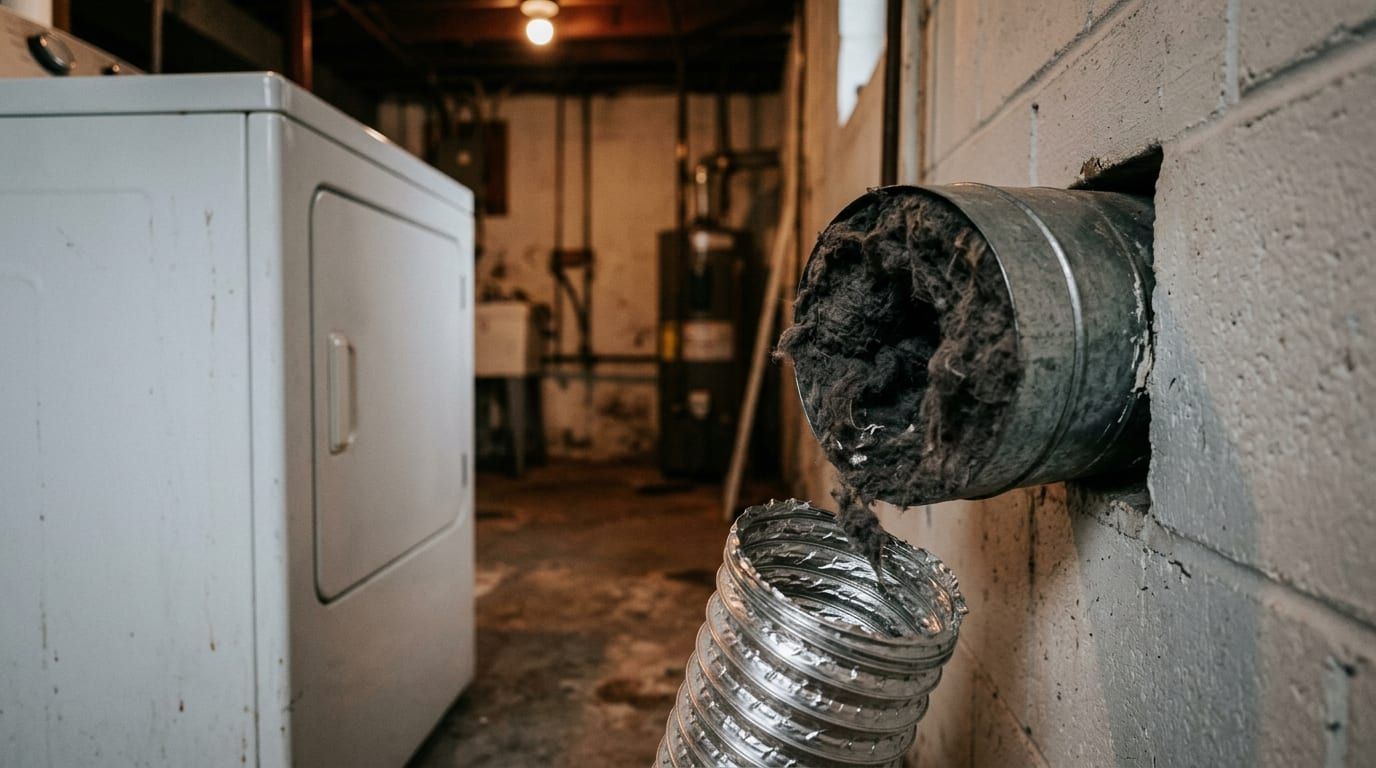
This is what a run looks like when the cycles have got longer
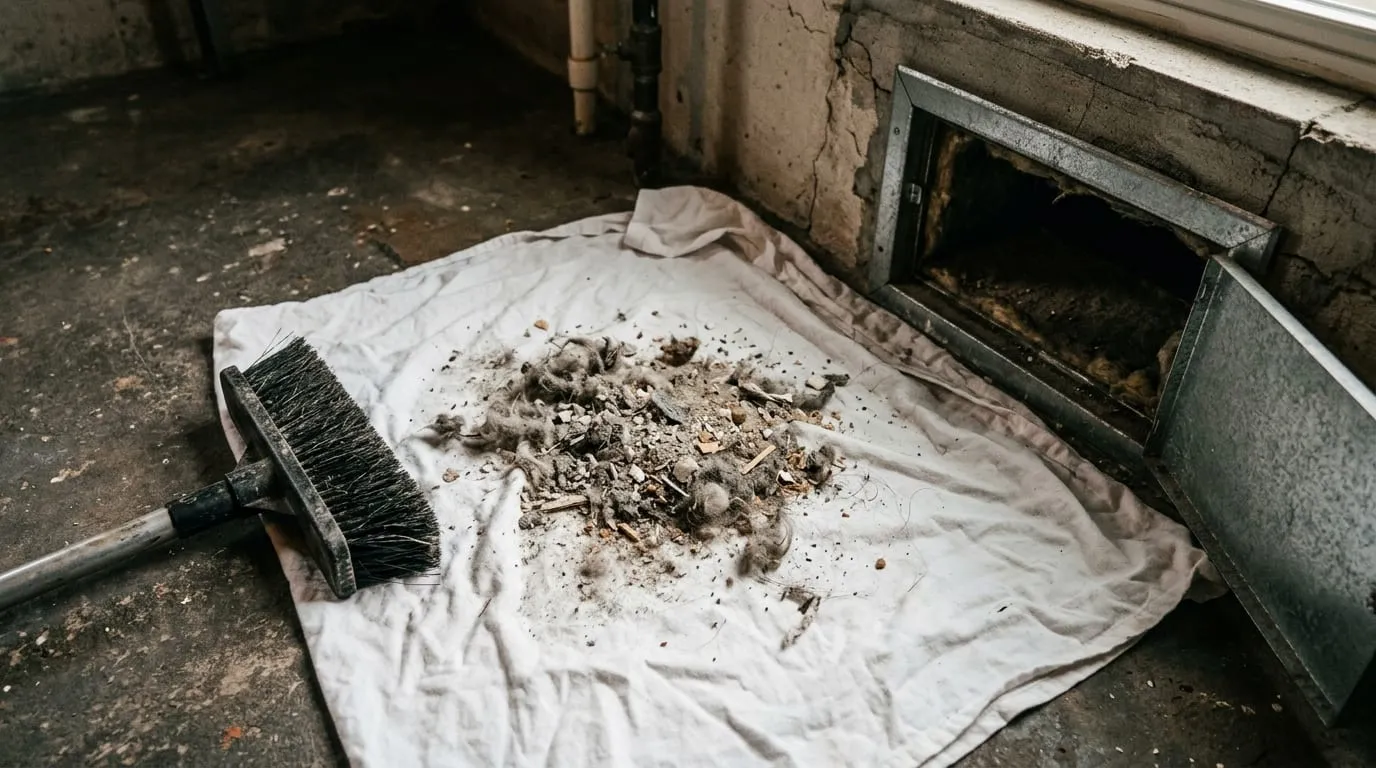
Out onto a sheet, not pushed along to the next elbow
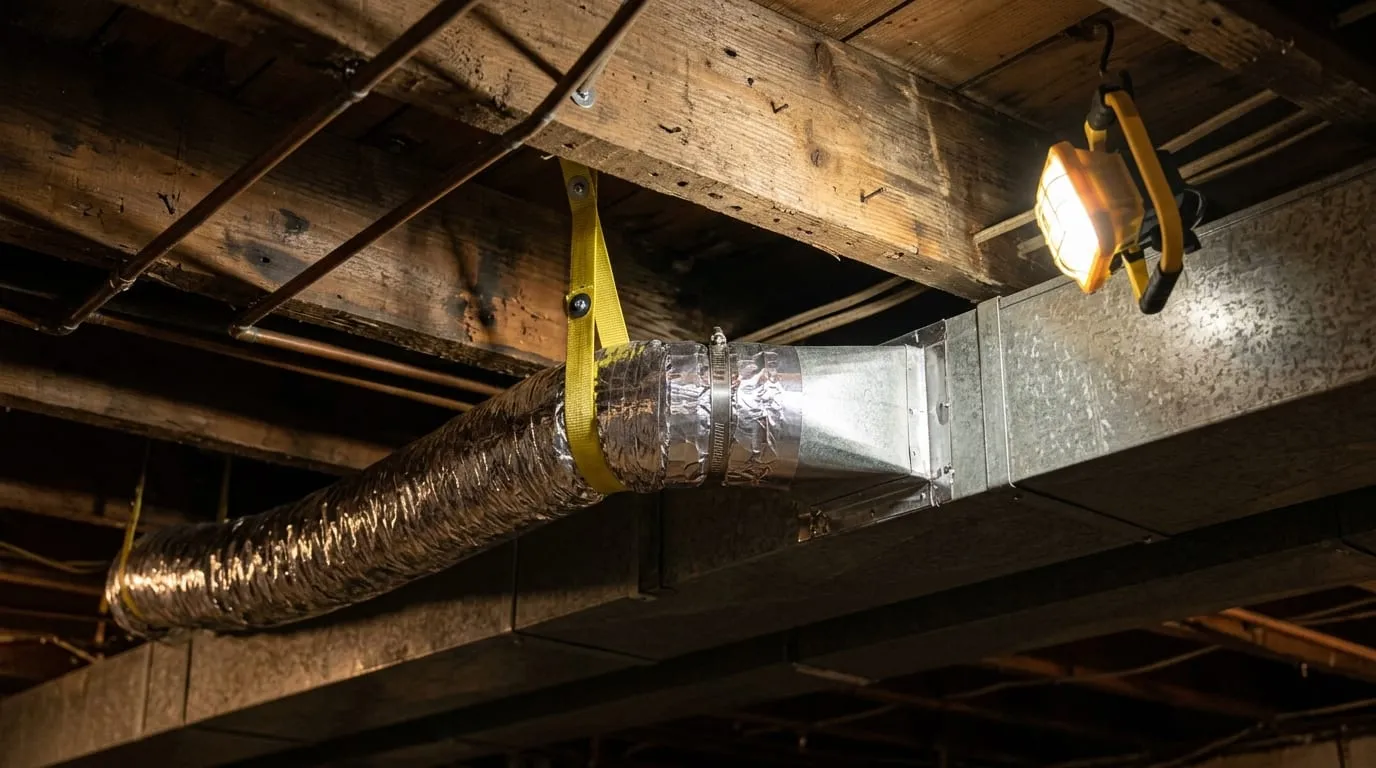
Where the transition hose was crushed, it gets replaced
What Bloomfield homeowners say
5.0
38 reviews on Google
Read on
Expert setup, high-powered vacuums, and absolutely no dust residue. Excellent work.
Water had been leaking around the chimney flashing, but the repair solved it completely. The crew sealed and reinforced the affected area with precision. Rain is no longer a concern. The workmanship looks strong and durable.
Questions about dryer vent cleaning
How often should a dryer vent be cleaned?
For an average household with a short run, about once a year. For a long run with several bends — which describes most basement laundries in older Bloomfield housing — sooner. The honest answer is that the machine tells you: when a normal load stops drying in a single cycle, the duct is due.
The screen gets emptied after every load. Why is that not the end of it?
It is worth doing and it is not enough. Lint gets past the screen on every cycle — no filter catches all of it — and what gets past settles in the duct where you cannot see it. The trap protects the machine; it does not keep the run clear.
Can you do the dryer vent and the chimney on the same visit?
Yes, and most people do. One trip, one set of coverings, both reports. Since we are already in the house for the chimney it is the cheapest time to have the duct looked at.
My dryer is in the basement and the duct is very long. Is that a problem?
It is not a fault, but it does mean the run needs clearing more often than a short one, because every rising section and every bend is a place lint settles. If the run is long enough to be marginal for the machine we will tell you, and sometimes the answer is a shorter route rather than more frequent cleaning.
Will I be able to tell it worked?
Yes, and you should check. Stand at the exterior hood with the dryer running before and after — the difference in airflow is the point of the visit and it is not subtle. If it is subtle, something else is going on and we would rather find that out while we are still there.
Other things we do
Air duct cleaning
Ducts are worth cleaning in a handful of specific circumstances and are sold to everybody else. This page is about telling those two apart before you book anything.
Read moreDuct repair and replacement
One room that never gets warm is rarely a thermostat problem. It is usually a duct that has come off, been crushed, or been leaking into a crawlspace for years.
Read more